
Overqualified Is a Real Problem, Just Not the One You Think
You passed the qualification question years ago. That is the difficulty: expertise compresses into intuition, and intuition does not transmit.
Justin Allan, NP4 min read
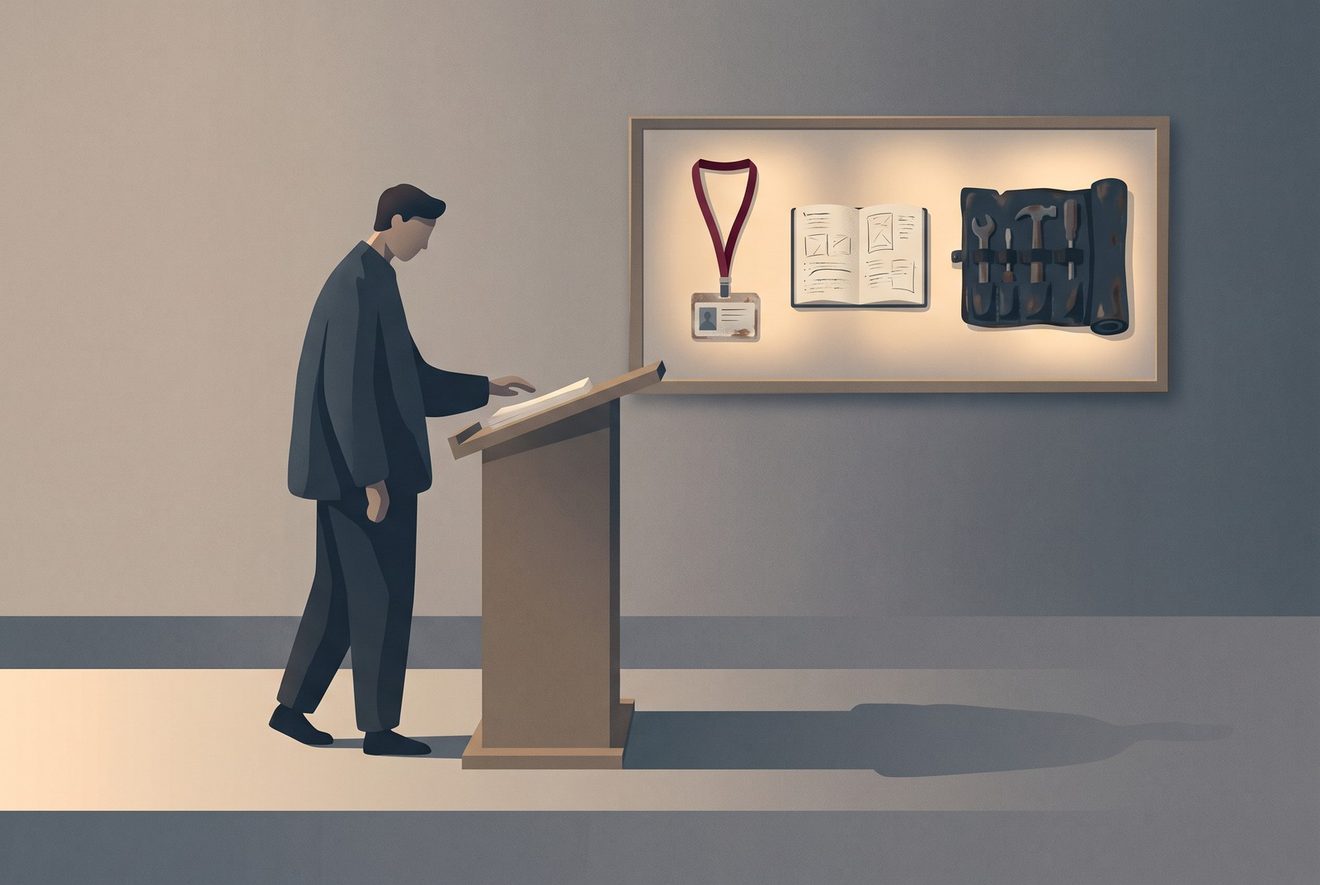
The objection, in the form people actually hold it: who am I to teach this? There are people in my field who know far more than I do.
True, and irrelevant, and I am going to spend one paragraph on it before moving to the part that actually matters.
There are always people who know more. There is no threshold at which the feeling resolves — people thirty years in still have it. What qualifies you is not standing at the top of your field; it is having solved a problem that somebody else still has. You cleared that years ago.
Now the real difficulty, which nobody warns you about, and which is the reverse of what you were worried about.
What expertise does to knowledge
Expertise is compression. That is what it feels like from inside as it happens — the thing that used to take four conscious steps now takes none, and you experience that as fluency.
What actually happened is that the steps got folded into a single move you no longer decompose. You do not decide any more. You look, and you know, and if somebody asks you why, you produce a plausible reconstruction rather than a recording, because the real process is no longer available to introspection.
Then a second thing happens, slower and more damaging: you forget that you ever did not know. The memory of the difficulty goes. You lose access to the state your student is in, which means you lose your only map of where they will get stuck.
That is the sense in which you are overqualified. It is not that your knowledge is too advanced. It is that it has become a shape that does not transmit.
The four symptoms
You have already seen all of these in yourself and read them as something else.
You skip. You explain steps two, three and five, because step four stopped being a step for you around your fourth year. The listener follows until the hole and then quietly stops following.
You answer the more interesting question. Somebody asks a basic thing; you hear the sophisticated version of it, because that is the version you find worth thinking about, and you answer that instead. They leave with an excellent answer to a question they did not have.
You qualify against cases they will never meet. You add the exception, because the exception is real and you have been burned by it. But your reader is four years from encountering it, and all it does now is make the main path look uncertain.
You assume the vocabulary. Not the technical terms — those you will remember to define. The ordinary shorthand your workplace uses, which you no longer hear as jargon at all.
Every one of these makes you sound more expert and makes the teaching worse. That is why competent practitioners so often produce courses that reviewers describe as thorough and unhelpful.
Decompression, which is the actual job
The good news is that this is a mechanical problem with mechanical fixes. None of them require you to be a natural teacher.
Record yourself doing the thing rather than writing about it. This is the single most effective method and it is borrowed from writing operating procedures: instead of documenting from memory, you capture yourself performing the task and describe what you are doing as you go. Memory gives you the tidy version. The recording contains the four small decisions you would never have written down, and those are the parts a learner needs.
Work from real questions, not from your own outline. You already have a supply — the things colleagues actually ask you. Those questions are formulated from inside the confusion, which is a place you can no longer get to by thinking harder.
Find where they stall, not where they disagree. Give a draft to one person a few years behind you and watch them use it. Do not ask if it was clear; they will say yes. Watch where they slow down, reread, or ask something you thought was obvious. That location is the missing step.
Then, for every step you wrote, ask what somebody would have to know already. Recurse until the answer is something a person in their position genuinely knows. It is tedious. It is also the entire difference between a course that works and one that impresses.
What this changes about the whole project
If the difficulty is decompression rather than accumulation, then the instinct to keep learning before you start is backwards. More expertise makes the compression worse. Waiting another two years does not make you readier; it moves you further from the person you are trying to reach.
It also means the beginner's advantage is real and temporary. The people best placed to teach something are frequently not the greatest experts but the ones who solved it recently enough to still remember the shape of not knowing. If you are five or eight years in, you are in that window now.
You have been asking whether you know enough. You have known enough for years. The question worth asking is whether you can still remember what it was like not to.