AI Made the Generic CE Course Cheap. It Did Nothing to What You Know.
Arranging information used to take forty hours and a payroll. It now takes about twelve and a chat window — which is a problem for the companies selling you CE hours, and an opening for everything you know that nobody ever wrote down.
Justin Allan, NP8 min read
Forty hours.
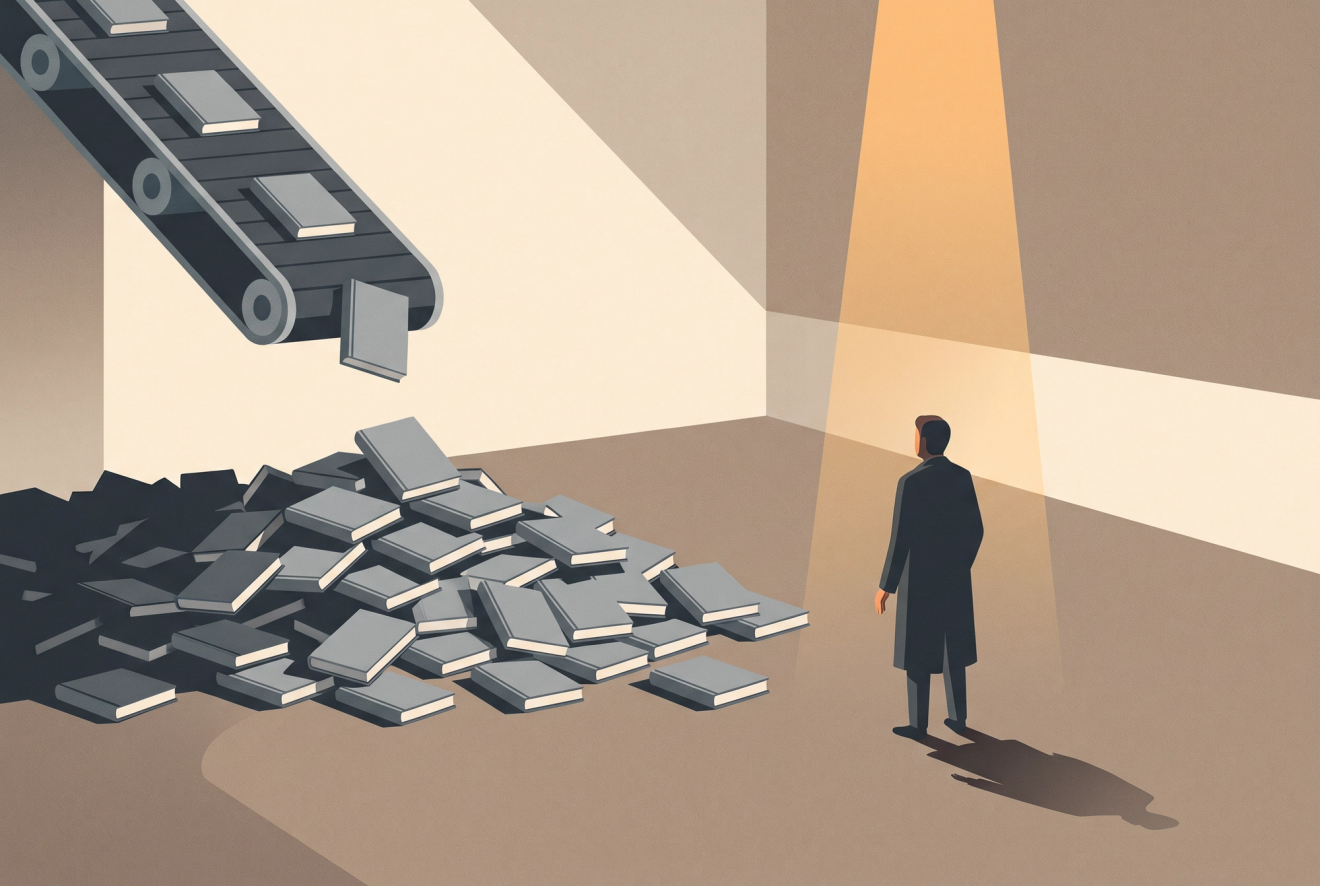
That is about what it took to build the slide deck behind a hundred-slide professional course. Forty hours of somebody sitting down and arranging what is known about a subject into an order that makes sense. It is the single largest cost in producing the kind of course you bought the last time you needed CE hours.
With a chat window open beside you, that same deck now takes something closer to twelve.
That number is not a productivity tip. Using these tools well is worth learning, and it is a separate conversation. This one is about what the number did to a business model that ran for decades.
Because it is a cause of death. The company that sold you your last CE course is standing a lot closer to it than you are, and the reason why is worth ten minutes of your attention even if you have never once thought about building anything.
Start with the course you already forgot
Pick the last one you bought. Slides, a voice, a quiz at the end, a certificate.
You cannot remember any of it. You remember that it counted, that the certificate went into a folder or an employer portal, and that you were relieved to be done. That is not a knock on you. It is a description of the product.
So the autopsy starts there. Why was it forgettable? Not because the people who made it were lazy. Walk it back properly and the forgettability turns out to be structural — it is the same fact that is now taking the business apart.
What was actually inside it
Organized information. Facts, definitions, the standard approach, the current guidance, arranged in a sensible order.
And arranged by whom? Almost always by somebody who read the same sources you could have read. Not somebody who had actually done the work for years and could tell you which part of the standard approach quietly stops holding up once you are doing it forty times a week. A writer with access to the literature and a deadline.
That is the whole product. Hold it in your hand for a second, because everything else follows from it.
Why that was ever a business
Because arranging information used to be expensive.
Forty hours a deck. Multiply that across a catalogue big enough to cover a profession's renewal requirements and you are looking at a payroll — writers, subject reviewers, editors, a production line. An individual could not do it. It took a company, and companies that got in early built the second half of the asset, which was distribution: the board approval, the employer contract, the search result, the fact that your licensing body recognized the name on the certificate.
Notice what is not on that list. Nowhere in it does anybody have to know anything unusual. The moat was cost and access, not insight. Which is why most large continuing education companies never built an audience in any real sense. They have buyers, who come back every renewal cycle because they have to, and no readers at all. Nobody follows a continuing education company. People were buying hours.
That model worked for decades, and it worked honestly enough. Arrangement was scarce. Scarce things command money.
What changed
Arrangement stopped being scarce, in about the space of two years.
Forty hours became twelve, and it fell on both sides of the transaction at once. That is the part people miss. It is not only that a producer can now assemble a hundred slides in a fraction of the time — it is that the buyer can get a competent, well-organized explanation of nearly any professional topic in seconds, free, arranged however they like, at whatever depth they ask for.
I built a diagram for one of my own courses by describing what I wanted and waiting about a minute. Five years ago I would have built it by hand, and it would not have been a minute's work. That is a small thing, and small things are the tell: when the cost of an entire category of work falls that far, the businesses whose margin lived inside that work do not get a grace period.
The twelve hours is a figure I recorded over a year ago and I would not defend it as current. It has only moved in one direction.
The cause of death, stated plainly
Their asset was never knowledge. It was the labor of arranging information, plus a channel to sell it through.
The labor just repriced. And a channel is only worth what it carries — the moment the thing being carried is available free, owning the pipe is a diminishing position, not a durable one.
Here is the part they cannot hire their way out of. They never bought the scarce input. They bought reading and writing. A business built on people who have read the sources can only ever produce what a careful reader produces, and that is now the exact output a machine hands out for nothing. The forgettable course and the failing model have one cause, not two.
The distinction that keeps this honest
I want to be careful here, because the sloppy version of this argument says organizing material is worthless now, and that is not true.
Sequence still matters enormously. Knowing what to cut, what order to teach it in, which step everybody gets wrong, where the tradeoff actually sits — that is worth real money and always will be.
But look at where that kind of sequence comes from. It comes from having run the process, not from having read about it. Two courses can look identical from the outside — same modules, same progression, same tidy structure — and one of them was ordered by someone reasoning from the literature, while the other was ordered by someone who has taught it badly a couple of times and moved the third section to the front because that is where people were actually getting stuck.
Information is easy to get now. Knowing what to do with it in front of a specific person on a specific day is not, and the second kind of sequence is judgment wearing the costume of organization.
What collapsed in price is the first kind. In practice, what a chat window hands you is a skeleton — a clean, correct, entirely generic skeleton. It is genuinely useful and it is genuinely not a course. It lacks the instinct. Skeletons are free now. That is the whole story.
The part that should make you uncomfortable
None of this makes you faster than the incumbents, and I would not let you walk away thinking it does.
The tools are on everybody's desk, including theirs. If I had these things when I was building the Elite Nurse Practitioner, I would have produced courses in something like half the time, and I would have been glad of it. Efficiency that everyone has is not an advantage. It is a new baseline.
And there is a version of this that does nothing for you at all. If what you know is only what you were taught — if your working knowledge is the standard approach, correctly retained and never once tested against a situation that did not match the description — then you are in the same position as the writer with the literature and the deadline. Generic input produces generic output whether a person assembles it or a machine does.
That is an honest disqualifier and I would rather say it than have you find out later.
Where the other kind lives
So the question is not whether you are an expert. It is whether any of what you carry around was never written down.
It usually is, and it usually sits in places that do not feel like knowledge:
- What you tell someone new in their first month that is nowhere in the onboarding material.
- The workaround for the thing your system, your software, or your process does badly — the one everybody in your department knows and nobody has ever documented.
- The sequence you actually use, which is not the sequence in the manual, because the manual was written by somebody who never had to do it with three other things happening at the same time.
- The four ways this particular thing goes wrong, and which of the four it usually is.
- The exception. The case where the standard guidance is right in general and wrong in front of you, and how you tell the difference.
- The thing you only know because you were there when it failed.
None of that is published anywhere. Not in the literature, not in the standard course, not in the answer a model gives — because a model can only read back what somebody wrote down, and nobody wrote this down. Including you.
Why you never noticed you had it
That last point is the whole thing, so I will put it directly.
You can only see the knowledge that has a name and a source. A certification, a degree, a protocol, a paper — those feel like knowledge because somebody handed them to you with a label attached. The rest does not feel like knowledge at all. It feels like how things work.
Which is exactly why, if somebody had asked you last week whether you had anything to teach, you would have said no. Not out of modesty. Out of a category error. The material you would have overlooked is the only material in professional education that did not just get commoditized, and the reason it stayed valuable is the same reason it stayed invisible to you.
I am not going to tell you what to do with that in this article. Notice it first. Most people go a whole career without.
Back to the number
Forty hours to twelve.
Every company whose product was the forty hours has a problem it cannot solve by working harder, because the thing they sold is now something their customer can produce over a coffee break. That is a genuinely difficult position and I do not say it with any pleasure.
You are in the opposite position, and you have been the whole time. Whatever you know that nobody ever bothered to write down did not get cheaper this year. It got scarcer, because everything around it got free.