
You Can Skip the Part That Costs Everyone Else a Year
Every other profession spends months building enough credibility for strangers to buy from them. Marketers can establish it in a single post.
Justin Allan, NP3 min read
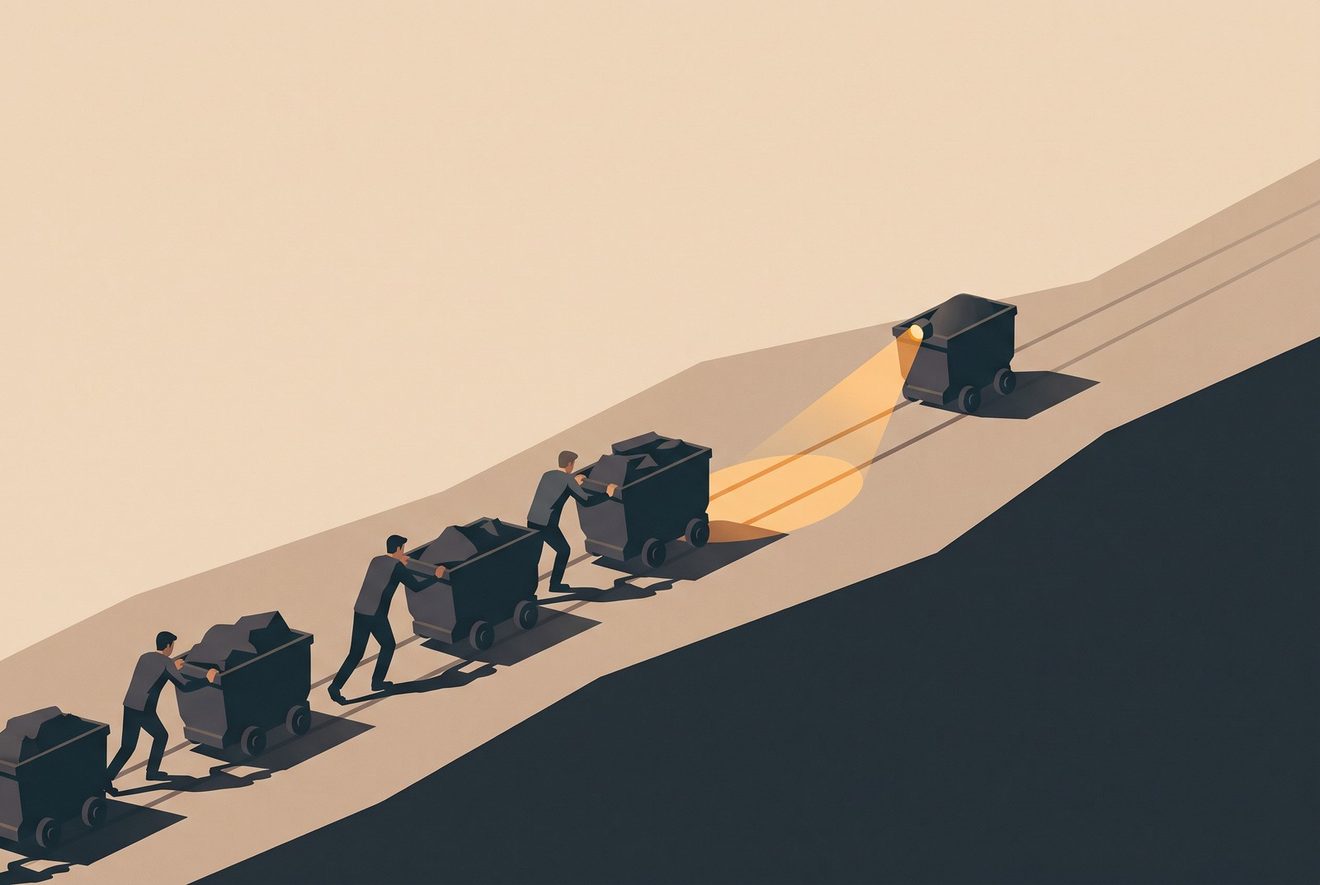
Six months. That is roughly how long it takes a professional starting a course business to build enough credibility that strangers will hand them money.
It is not a marketing problem in the ordinary sense. It is that a physiotherapist or an accountant has no way to show you they are good. They can tell you, and telling is worth almost nothing to a stranger, so they publish for half a year until the accumulated evidence does the job.
You do not have that problem, and you may never have noticed it was a problem.
The comparison
Take two people launching a course in the same month.
The accountant knows exactly what she is doing. Fifteen years, complicated clients, genuinely good. She writes a sales page. A stranger reads it and has no method available to verify a word of it — the work happened inside private client relationships, under confidentiality, with outcomes nobody outside the firm can see. So the stranger does the sensible thing and waits. She spends the next six months publishing until enough people have read enough of her thinking to conclude she is credible.
The marketer launches the same month. Somewhere in his history is a campaign that worked, and unlike the accountant's work it left a trail: the numbers, the creative, the before and after. He publishes one breakdown of it — what he tried, what failed first, what the shift was, what happened to the figures.
A stranger reads that and knows within four minutes whether he is worth listening to.
That is the whole advantage, and the claim needs to be exact: not that marketers are better teachers, but that marketing is one of the very few professions where competence produces public artifacts. You are not compressing the credibility phase through skill. You are skipping a constraint the others cannot skip.
What this changes about how you start
Three practical consequences.
Lead with the artifact, not the biography. The instinct is to open with your résumé — years, clients, agencies. Nobody outside your industry cares and nobody inside it believes a résumé. Open with a thing that happened and the numbers around it. The credential is the artifact.
You can charge earlier. Most professionals should not put a serious price on a course until they have built an audience, because the price is a claim about trust they have not yet earned. You can compress that. The evidence is doing what six months of content does for everyone else.
Your free content is a portfolio, not just teaching. Every breakdown you publish serves twice — it helps the reader and it demonstrates the thing you are selling. That double duty is unusual and you should exploit it deliberately, choosing what to publish partly on the basis of what it proves.
The catch, which is real
Your market is the most marketed-to audience alive.
Marketers recognize every technique, because they use them. The urgency mechanics, the scarcity framing, the structure of a launch sequence — your buyers can name all of it while reading it. That neutralises most of the standard playbook and it is why a lot of courses sold to marketers feel faintly embarrassing to the people receiving them.
What survives contact with that audience is specificity. Not "how to run better ads" but the exact account structure that fixed a specific problem, with the numbers, including the parts that did not work. Your audience has an unusually high floor for what counts as useful and an unusually low tolerance for being handled.
Which suits you, because specificity is what you already have.
Choosing what to teach
One narrowing step, and it is the same one every profession has to do.
You know a lot of marketing. Nobody buys "a lot of marketing." What sells is one problem, held by one identifiable group, that you have solved repeatedly — the local service business that cannot make paid search work, the founder-led brand whose organic reach collapsed, the team whose attribution stopped telling them anything true.
Pick the one you have solved most often, not the one that sounds most impressive. Then find the artifact that proves it and publish that first.
Everyone else in this business spends their first half-year earning the right to be believed. Do not spend yours the same way. You have already got the receipts.