Your Portfolio Got Better. Your Position Did Not.
Creative careers do not accumulate. Every project starts at zero and the deliverable belongs to someone else. The only asset that survives is taste.
Justin Allan, NP4 min read
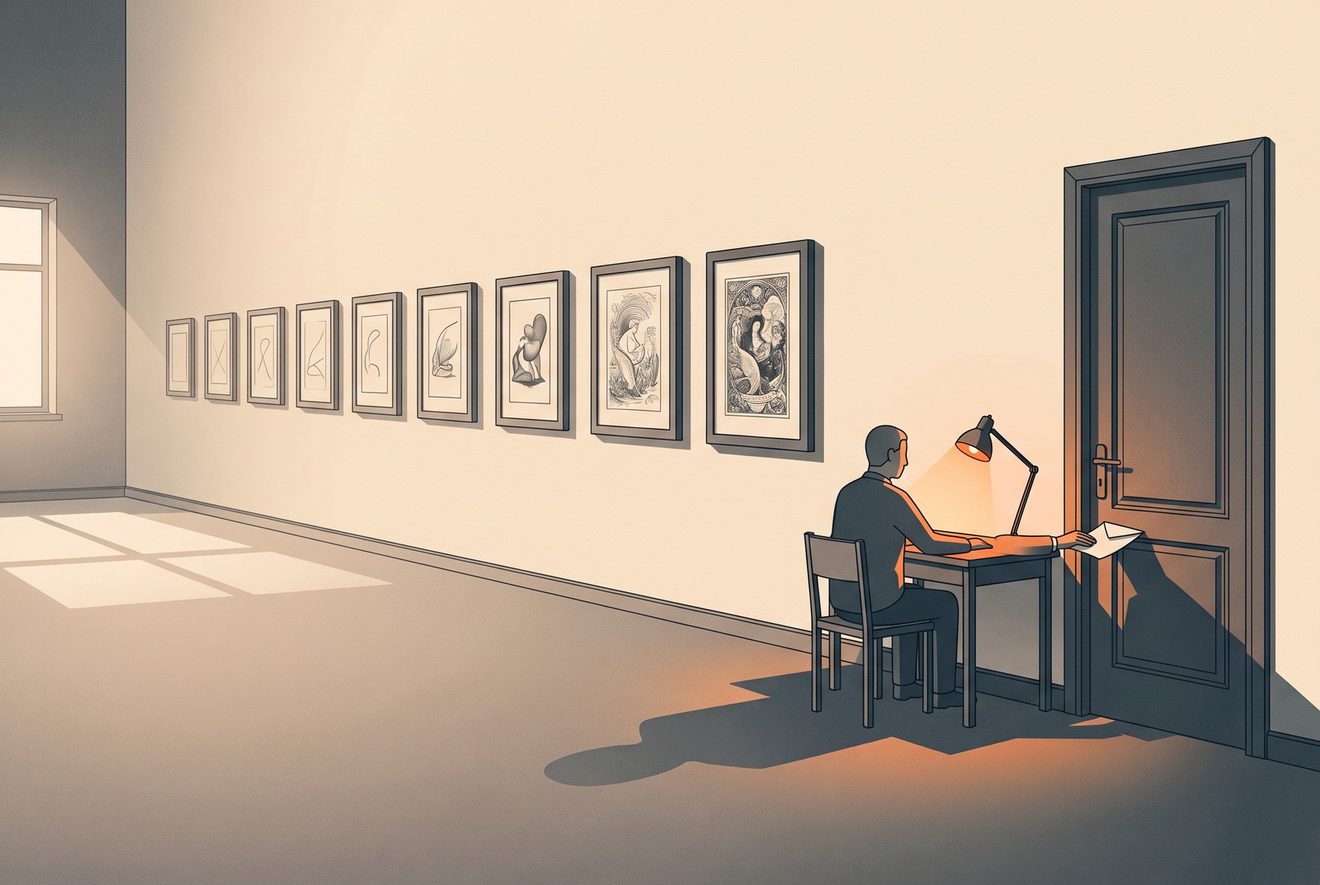
Put your work from year three next to your work from year fifteen.
The difference is enormous, and you can see every bit of it — the restraint you did not have, the problems you now solve before anyone notices there was one, the fifty decisions per page that used to take a week and now take an afternoon.
Now compare the two positions rather than the two portfolios. Year three: waiting on a brief, scoping from scratch, explaining your value to somebody who has not worked with you before, invoicing at the end. Year fifteen: the same, at a higher rate, with better clients and less patience.
Twelve years of improvement bought you a price change. It did not buy you a structure change. That is the actual condition of a creative career, and the reason deserves a blunt answer.
Nothing accumulates
Everything you make belongs to someone else. That is not a complaint about the deal — it is a correct deal, you were paid, the client owns it. It is a statement about what is left behind.
A brief comes in, you solve it, you hand it over, and it goes onto a portfolio which functions entirely as evidence that you can be hired to do it again. Then the next brief arrives at zero. Nothing carries forward except your own competence, and competence is stored in one place: you.
Which means the asset cannot be separated from the person, cannot run without them, cannot be sold, and stops the moment they stop. Every other kind of business builds something that exists apart from its founder. Yours structurally cannot, no matter how good you get.
What you actually own
Here is the part I want you to sit with, because creatives consistently misidentify their own asset.
You think the asset is the work. It is not — the work is the residue.
The asset is the judgment that produced it. Why that typeface and not the one that was nearly right. Why the scene loses nothing by starting eleven seconds later. Why the second version was worse despite being more interesting. Why you killed the idea everyone in the room liked.
That judgment is the single hardest thing to acquire in any creative discipline. Software is learnable from a tutorial in a weekend. Taste takes a decade, is transmitted almost entirely by apprenticeship, and is currently possessed by you in a form nobody can access.
And there is an enormous population of competent, well-equipped younger practitioners who can execute anything and cannot tell whether what they have made is good. They are not short of tools. They are short of a reason.
Before: you post the work
You already do the hardest part of building this business. That is the thing worth noticing.
You publish, consistently, to an audience of people in your field. Most professionals thinking about a course business have to build that habit from nothing over months. You have had it for years.
But look at what your posts actually are. A finished piece. Maybe a caption naming the client. The implicit request is: look at this, admire it, remember me when you need someone.
That produces admiration, occasional referrals, and no business, because it is a showcase and showcases do not accumulate anything either. The people watching are mostly your peers, and peers are not buyers.
After: you post the reasoning
Change one thing. Publish the same work, and say what the decisions were.
Show the version you rejected. Explain what was wrong with it — specifically, not "it didn't feel right." Name the constraint the client gave you that nobody watching would guess. Say which part you still think is weak.
This is a different product entirely, and it does a different job. Content works when it is built around a problem somebody has, not around a thing you made. A finished piece is not a problem. "How do you know when to stop" is a problem. "The client keeps asking for changes that make it worse" is a problem. "I can execute anything and I cannot tell what is good" is the biggest problem in your field and nobody is addressing it seriously.
Do that consistently and the audience changes character. It stops being peers admiring you and starts being practitioners learning from you — and practitioners learning from you will pay for a structured version of it.
What you sell then is not a software course. Do not build a software course; that market is fully served, largely free, and it will not carry a price. Sell the judgment: the critique, the decision- making, the part of the job that took you twelve years and that nobody has ever written down for the person six years behind you.
What changes
Same skills. Same work. One thing added underneath it that keeps existing when you are not working.
The next brief still arrives at zero. But it is no longer the only thing in the business, and for the first time in your career something is accruing in your own name.