Complexity Is a Slow Leak
Course businesses rarely fail from one bad decision. They fail from accumulated complexity, each piece of which looked justified on its own.
Justin Allan, NP4 min read
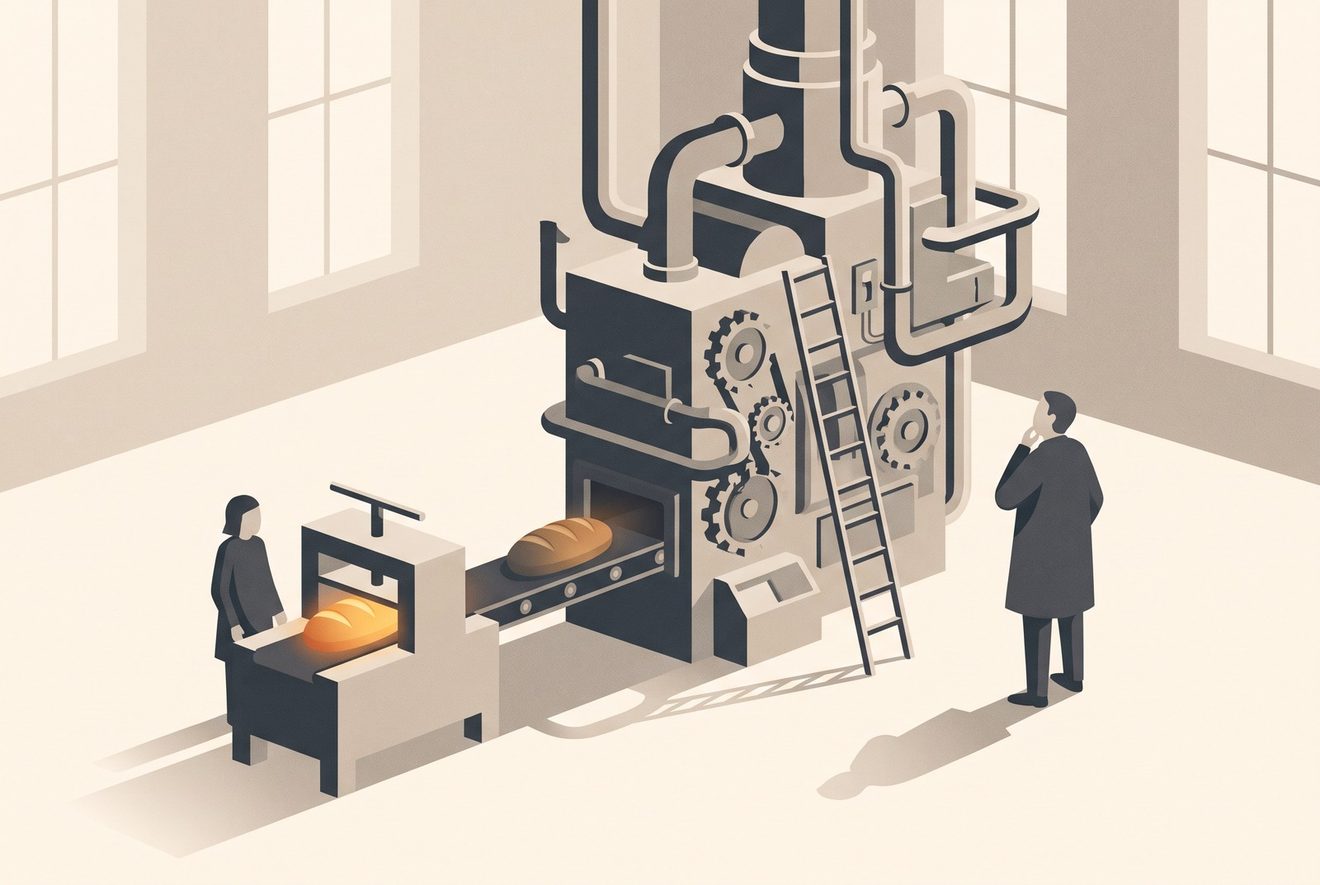
Nobody sinks a course business by making one catastrophic decision. It happens like this instead.
Month four, a second product, because a customer asked. Month seven, a third channel, because somebody said you should be on it. Month nine, a scheduling tool, an analytics tool, a design subscription — thirty or forty dollars each, all defensible. Month fourteen, a bigger idea: your own platform, or an app, because the one you rent does not do the one thing you want.
Every decision was reasonable when it was made. Eighteen months in, revenue is up and the business feels heavier than it did when it earned half as much, and the owner concludes they need to work harder.
They do not. They need to work back through the list.
The autopsy
Take any stalled course business and the causes tend to sort into three, in ascending order of damage.
Subscriptions nobody audits. Individually trivial, collectively a real number, and the cost is not mainly the money — it is that each one is a thing to configure, maintain, remember and eventually migrate.
Products that do not fit. A second and third course added because they seemed like growth. Each one needs its own sales page, its own support, its own updates. If it does not sit inside the same value proposition, it consumes attention permanently and returns very little.
Custom software. This is the expensive one, and it is where a well-funded course business goes to slow down. Building your own platform or app can run to six figures, and it converts you from somebody who teaches into somebody who maintains software.
Notice what all three share: none of them made the product better or reached one more professional. They all added surface area.
The question that prevents all of it
Before any expense, one question, asked honestly:
Is this going to increase my profitability, or is it genuinely necessary to keep the business operational?
If the answer is neither, you have found something to decline. That is most of expense discipline in a business like this.
It is deliberately a low bar and it still catches a great deal. Not "is this useful" — plenty of useless things are useful. Profitability or operational necessity, one or the other, or it does not get bought.
A hundred dollars on a plug-in that speeds up your site does not need this scrutiny; the amount is noise. Six figures on custom software absolutely does, and so does the fourth monthly subscription, because that one is establishing a pattern rather than a cost.
The tension worth knowing about
I want to be straight about a place where the advice genuinely cuts both ways.
Proprietary software can materially raise what your business is worth at sale. A buyer looking at a company that owns its own platform will pay a higher multiple than for one renting the same tools as everyone else. That is real.
It is also true that building it early is one of the most reliable ways to stall. The difference is entirely stage. At eighteen months, with an audience you are still assembling, custom software is a distraction wearing a strategy costume. At year five, with the revenue to fund it and a clear reason it makes the product better, it can be the best money you spend.
The test is not whether it is a good idea. It is whether you can afford for it to fail.
Why simplicity pays twice
The first payment is speed. A simple business is faster to change, cheaper to run and much easier to hand to somebody else, which is the only route to it not needing you.
The second is at the end. Buyers actively prefer a simple business — low integration effort, limited operational complexity — because they have to fold it into their own operation, and every awkward custom thing you built is work for them. A complicated business is not merely worth less in theory; it is harder to sell at all.
So the tangle you accumulate at month fourteen is charged to you twice: once in the years you spend running it, and again in the discount when you try to leave.
What to do about it
Two things, this month.
Audit the stack. List every recurring cost and every product line. Against each one write whether it increases profitability or is necessary to operate. Cancel what fails both. Something will, and probably several things.
Keep a buffer instead of a tool. Three months of operating expenses sitting in the account, untouched, does more for the business than any subscription. Treat that number as though it were zero — if your monthly spend is ten thousand, then thirty thousand in the bank is your empty balance. That buffer is what lets you keep marketing through a slow quarter, which is precisely when most people stop.
Simplicity is not minimalism as an aesthetic. It is refusing to acquire obligations that do not pay for themselves, repeatedly, for years, while everyone around you mistakes accumulation for progress.