
Is Your Course Worth $500? Prove It Before You Price It
Your $500 course earns its price with a consequential outcome, a complete and clear solution, and a fair price—not runtime, polish, or premium positioning.
Justin Allan, NP7 min read

You have a number in your head for your course. Let’s say it is $500. Whether that number is right has nothing to do with how many videos you recorded, how many modules you built, or how polished the production looks. It comes down to one question: what does your buyer walk away able to do, and what is that worth in their professional life?
So before you put a price on anything, sit on your buyer’s side of the table for a few minutes. A working professional does not spend $500 casually. They will ask hard questions of your course. Ask those questions first, and the price gets much easier to defend.
One rule before we start: I price routes, not results. I never promise a buyer a specific outcome, and neither should you. What your course has to do is give the right person a complete, clear route through a real problem. That is what earns the price. Everything below is how you prove it does.
Nobody judges $500 in isolation
People ask me whether $500 is expensive for an online course. The question is too broad to be useful.
Expensive compared with what? A book? A semester of school? A day of consulting? A free video? Those are different products built to do different jobs. The useful comparison starts with your buyer, their problem, and the outcome.
Who is the course for? What are they trying to do? What keeps going wrong without a clear process? If the course helps them move through a consequential professional problem, the outcome may be worth far more than the price. If the promise is vague, $500 is too much — for them, at any production quality.
A high price does not prove quality. A low production cost does not erase customer value either. Your effort and your buyer’s outcome are not the same thing.
I can work hard on a course nobody needs. I can also organize a focused solution that saves the right person from months of scattered searching. The market does not owe me money for effort. The buyer pays for a useful path through a real problem.
That is why $500 is not a magic number. It is a case your course has to earn.
Value is the result, not the runtime
Videos, modules, downloads, and hours describe the container. Production polish describes the presentation. None of it establishes value.
That does not mean quality is irrelevant. Clear audio matters. Useful examples matter. Good organization matters. A professional course should respect the learner’s time. But more content is not more value.
What I want to know is what changes when the learner applies the teaching. Can they approach an important task with a clear process instead of piecing together conflicting sources? Can they make a professional decision with better structure? Can they skip the friction everyone else hits because the course puts the work in the right order?
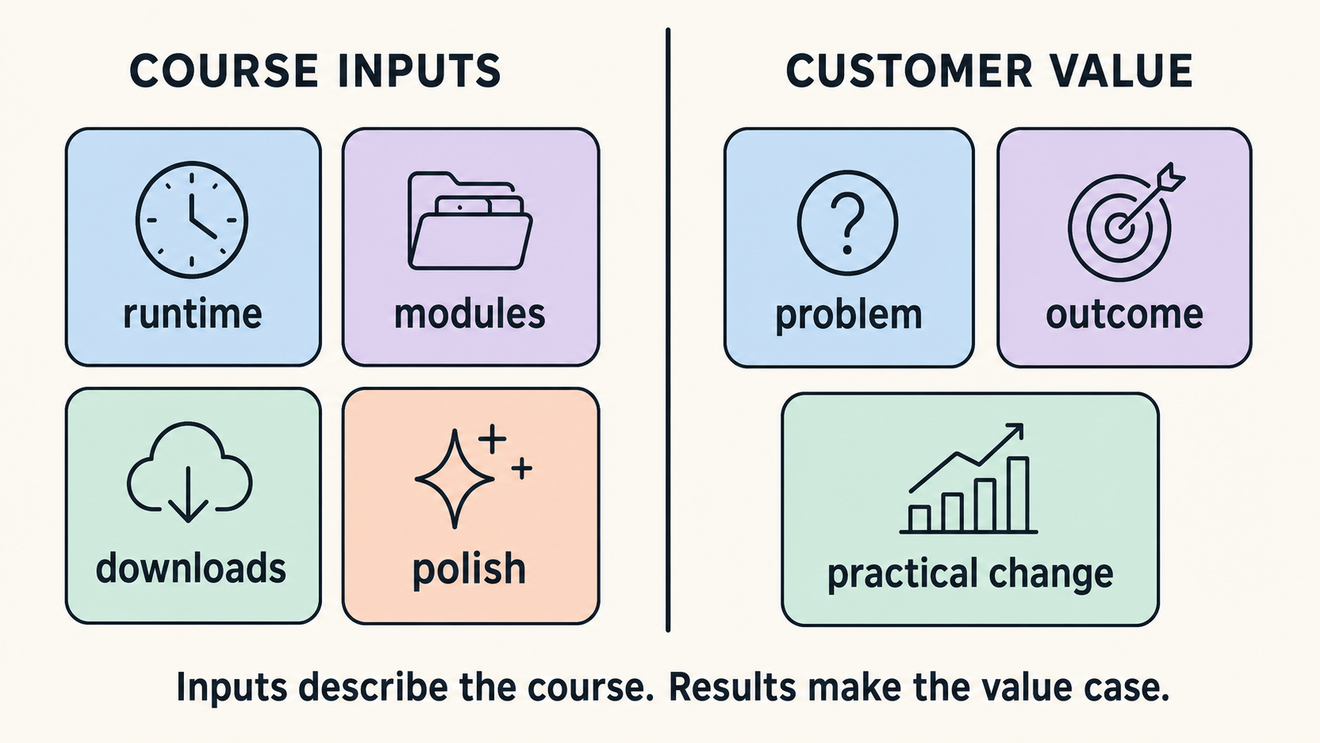
This is where creators hide behind volume. It feels easier to promise a long video list than to define one useful result. It feels safer to add another module than to decide what the learner should be able to do by the end.
But runtime is not the result. A content pile can be long and still leave the buyer lost.
A focused course still has to be a complete solution
Focused does not mean unfinished.
I am not talking about selling an MVP, a pilot, a beta, or a partial product and asking the buyer to imagine what it might become. A paid professional course delivers the complete solution it promises.
The promise can be narrow. A narrow promise is usually easier to understand and easier to fulfill. But the course cannot stop halfway through the problem.
My test for completeness is functional. Does the course carry the learner through the defined problem in a clear, usable sequence? Does it explain what they need to understand, show them how to apply it, and give them a practical way to move forward? Or does it hand them a collection of information and leave them to build the solution themselves?
There is no universal number of modules, worksheets, or support calls that makes a course complete. Different problems need different solutions. A process course may need demonstrations and a template. Another course may need practice, feedback, or a decision tool. The promise determines what belongs.
Clear and straightforward can be complete. Fancy and complicated can still be empty.
The point is not to make the course bigger. The point is to make the solution whole.
This is the kind of question a conversation settles faster than an article can.
Bring your subject, your profession, and the number you already have in your head. We will talk through what it would actually take.
Make the outcome concrete
“Transform your career” is not a value case. It is an aspiration.
When I build the case for a course, I look at five kinds of practical value:
- Time. How much time does the unresolved problem eat — searching, rework, confusion, a process rebuilt from scratch every time?
- Money. Does the problem create a cost, delay, or risk the buyer can describe honestly?
- Professional capability. What can the learner do better after working through the course?
- Confidence. Does a clear process replace scattered information with a path they can actually use?
- Avoided friction. Which mistakes, dead ends, and repeated decisions does the teaching remove?
If you cannot support a number, do not invent one. You do not need fake precision to make a strong case. You need a specific problem, a credible outcome, and an honest explanation of why that outcome matters.
Your buyer is also comparing you to the alternatives: free information, books, another course, direct help, doing nothing. You do not have to beat every alternative on price. You have to explain why your organized path is worth choosing for this problem and this person.
Specific language makes value easy to judge. Inflated language hides it.
Fair pricing is part of the value
Once I understand what the outcome could be worth, I ask a different question: what is fair to charge?
I learned this one the uncomfortable way. When I priced one of my early courses, the standard advice was everywhere: the problem is worth thousands, so charge thousands. Anchor high. Premium positioning. I sat with that for a while, and it never felt like the business I wanted to run. The people I was teaching were the same kind of professionals I had worked beside. I set a price I could defend to a colleague’s face, and I have priced that way since.
My philosophy is simple: charge a reasonable, fair price — not the most the problem could justify.
Value-based pricing exists to stop you from pricing off your production cost. It is not permission to extract the maximum from every buyer. Those are different ideas.
A fair price also lets more of the right people say yes. Accessibility can be a deliberate way to build a larger base of customers. And price alone was never the argument anyway. Some sellers use it as one: expensive means premium, premium means better. I do not build a value proposition on perception. A buyer still needs a useful result, a complete solution, and a fair deal.
So treat $500 as a number to justify, not a badge of quality. The outcome has to carry it. The course has to deliver. The price has to make sense beside the alternatives.
A valuable problem is not a blank check.
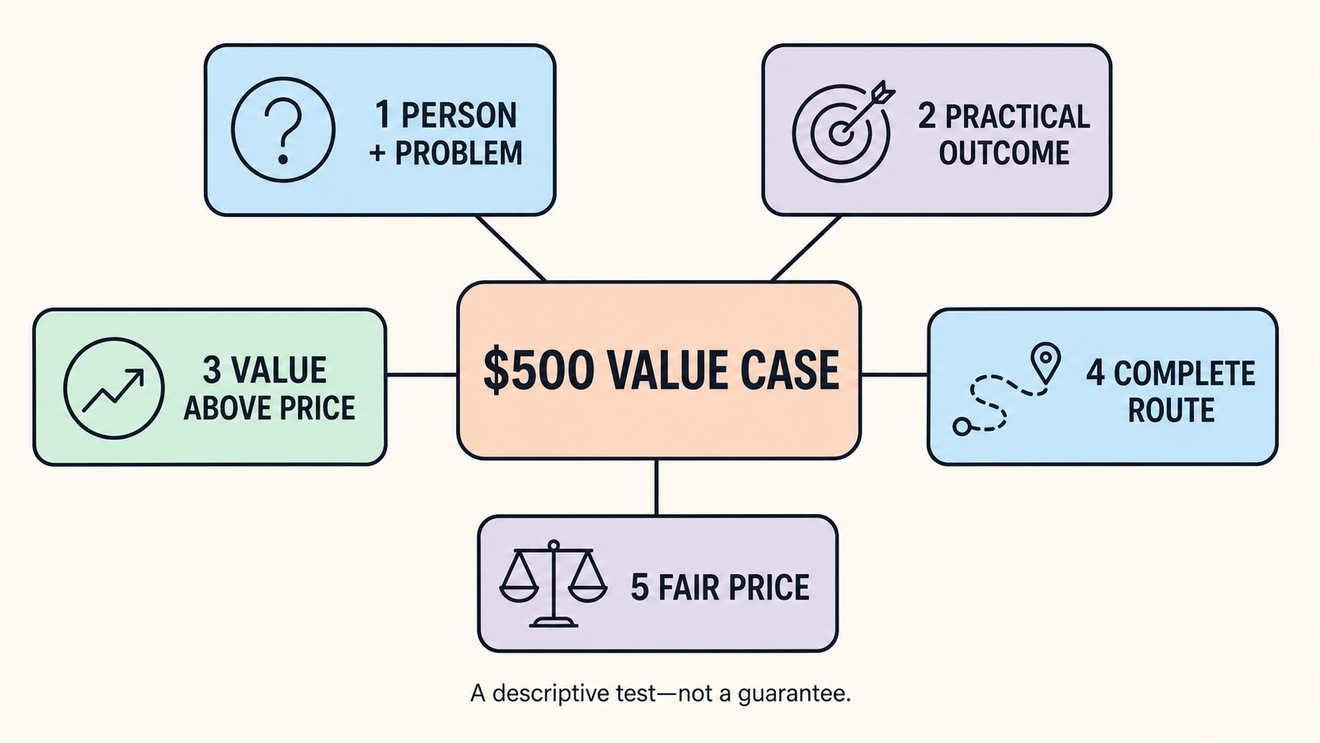
Write the value case before you set the price
Before $500 goes on your sales page, write the case in plain language. One page.
Five questions:
- Who is the specific professional, and what consequential problem are they trying to solve?
- What practical outcome does the course help them pursue?
- Why could that outcome matter more than $500 to this buyer?
- Does the course provide a complete, clear route through the promised problem — not a content pile, not a test balloon?
- Is $500 fair beside the value and the alternatives, or are you using price to manufacture prestige?
Here is the difference the case exposes. Picture a nurse practitioner who needs a better way to handle one recurring documentation workflow. Course A is a large, polished video library — hours of material across every adjacent topic, impressive to scroll, and the learner still has to figure out what applies, in what order, to their specific workflow. Course B is narrower: it defines the documentation problem, walks a clear process, demonstrates it in realistic situations, and hands the learner the resources to run it themselves.
Course A has more production. Course B creates more value for this buyer, because it does the work of turning information into action.
That is the distinction. Focus is not the absence of substance. A focused course earns its price when everything inside it serves the promised result.
Now write your own case. If you need words like “premium,” “exclusive,” or “comprehensive” to make the offer sound valuable, the case is not ready. Replace the adjectives with the person, the problem, the outcome, and the path.
The final test
Five hundred dollars is neither automatically cheap nor automatically expensive.
A worthwhile $500 course has three things: a consequential outcome, a complete and clear solution, and a fair price. Remove any one and the case collapses.
Finish this sentence:
This course is worth $500 because it helps [specific professional] move from [specific problem] toward [specific outcome] through [clear, complete route].
Read it without the price. Does the course still sound useful? Read it without the adjectives. Is the outcome still clear? Now look at your actual curriculum. Does it deliver the route in that sentence, or does it just surround the problem with information?
That is the work. Not adding hours. Not manufacturing prestige. Not charging for how hard the course was to make.
Solve a real problem clearly. Build the complete, focused course. Then choose a price that is a good deal for the buyer and fair to you.